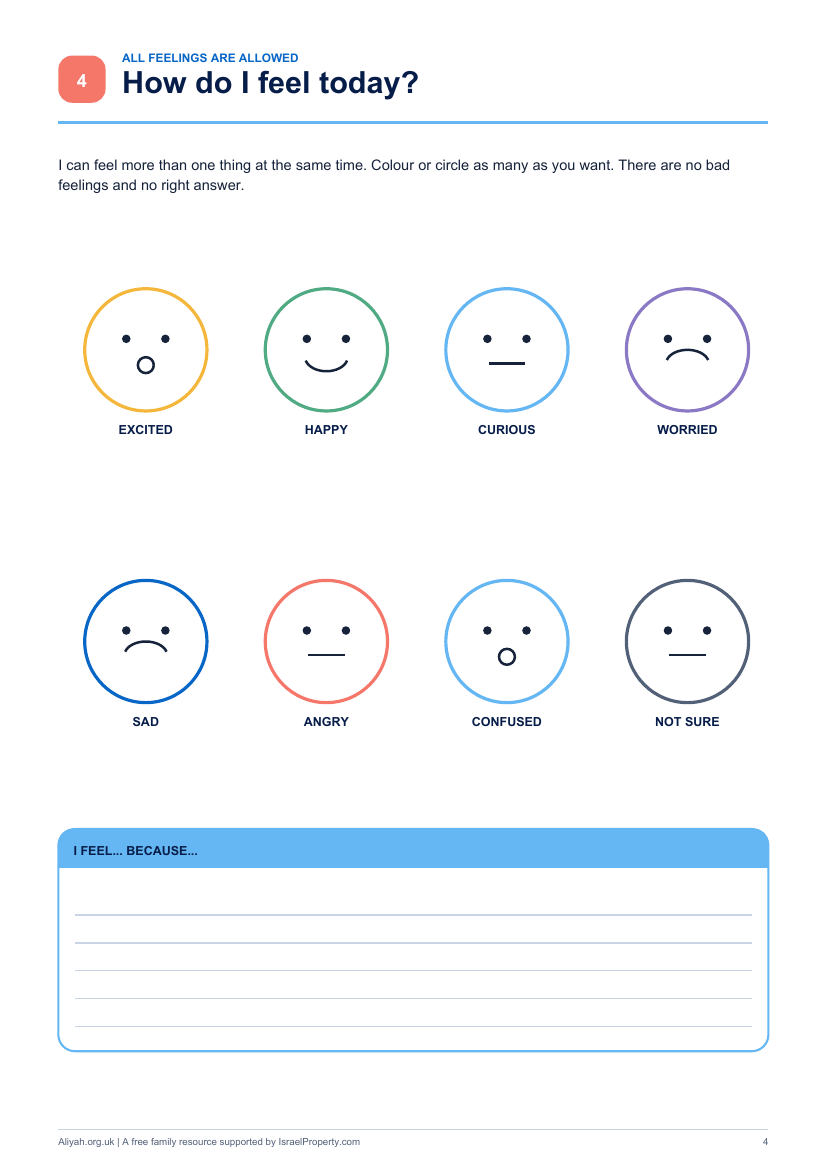
Each stage names what is happening, makes room for different feelings and offers one small thing to do together.
1
We're thinking about Aliyah
What's happening?
Your family is talking about moving from the UK to Israel. Nothing has to make sense all at once.
How might I feel?
curiousexcitedworriednot sure
Let's do something
Draw what you think Israel might look, sound or feel like. Add every question you have.
ישראל
A word to learn
Yisrael - Israel
For grown-ups
Explain what is being considered, what is not decided yet and when you expect to know more.
2
We're getting ready
What's happening?
Grown-ups may be filling in forms, having conversations and finding out what the family needs.
How might I feel?
interestedimpatientleft outcalm
Let's do something
Make a family getting-ready list with one small job you would like to help choose.
משפחה
A word to learn
Mishpacha - Family
For grown-ups
Include children without making them responsible for application decisions or paperwork.
3
We're choosing what to take
What's happening?
Some things will travel with you. Other things may be packed, given away or left with someone you trust.
How might I feel?
excitedprotectivesadoverwhelmed
Let's do something
Draw a suitcase and add a comfort item, toy, book and something that feels like home.
בית
A word to learn
Bayit - Home
For grown-ups
Offer a few real choices and protect familiar objects that support comfort and routine.
4
We're saying goodbye
What's happening?
You may say goodbye to people, school and places you love. Goodbye can also mean see you again.
How might I feel?
sadangrythankfulhappy
Let's do something
Choose one goodbye you want: a special day, a card, a photo book or a favourite-place visit.
להתראות
A word to learn
Lehitraot - See you again
For grown-ups
Give goodbyes time. Do not use a forced celebration to cover sadness or anger.
5
It's travel day
What's happening?
Today may be busy. You will travel with your family and the grown-ups will look after the important plans.
How might I feel?
excitedtiredscaredall mixed up
Let's do something
Use the Travel Day page to draw what you might see and name one thing that could help.
מטוס
A word to learn
Matos - Aeroplane
For grown-ups
Describe the next one or two steps, keep a comfort item close and leave space for difficult feelings.
6
Welcome to Israel
What's happening?
You have arrived. There may be new signs, sounds, weather, food and people around you.
How might I feel?
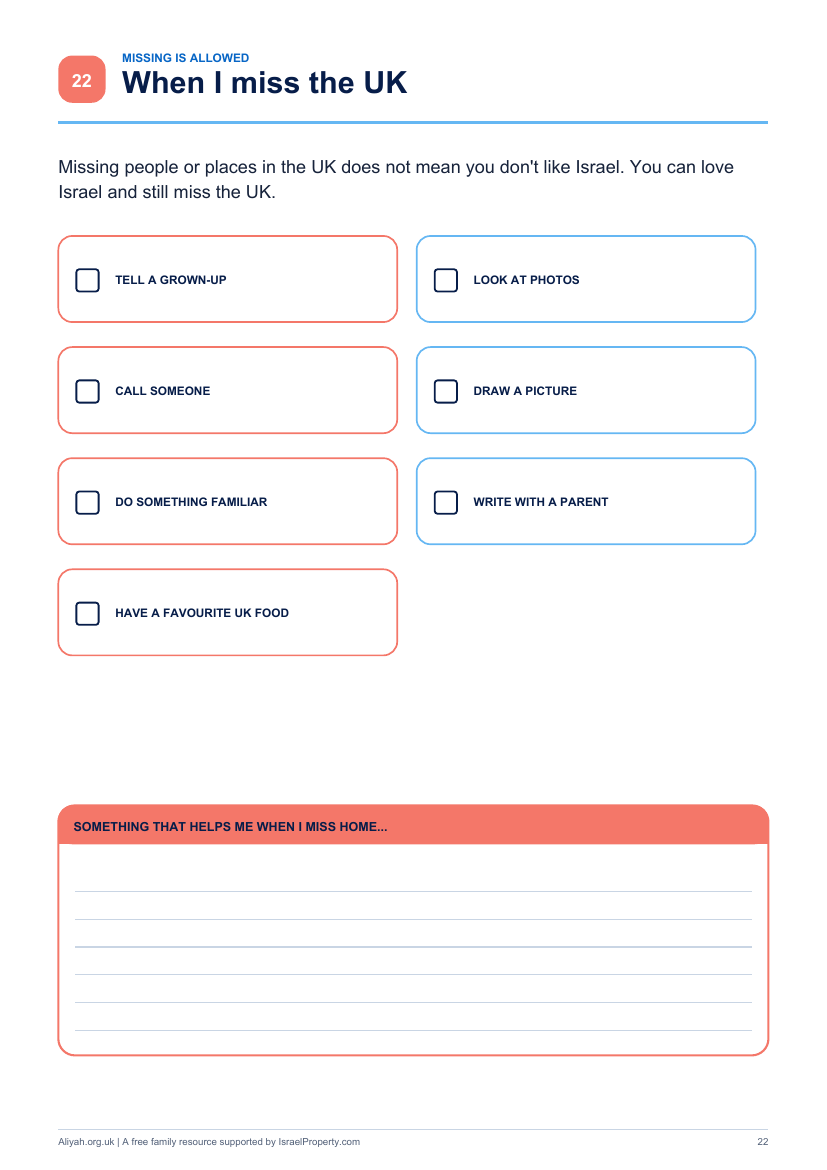
amazedshyhappymissing the UK
Let's do something
Notice three things: one familiar thing, one different thing and one thing you want to ask about.
שלום
A word to learn
Shalom - Hello
For grown-ups
Keep the first explanation simple. Arrival is a beginning, not proof that a child has already settled.
7
My new routine
What's happening?
Home, school, friends and Hebrew begin to form a new routine. It takes time to know where things belong.
How might I feel?
proudlonelyconfidentfrustrated
Let's do something
Draw a new-school day and add who you can ask for help, a Hebrew word and something still difficult.
בית ספר
A word to learn
Beit Sefer - School
For grown-ups
Check in more than once. Siblings can settle at different speeds and both experiences are real.
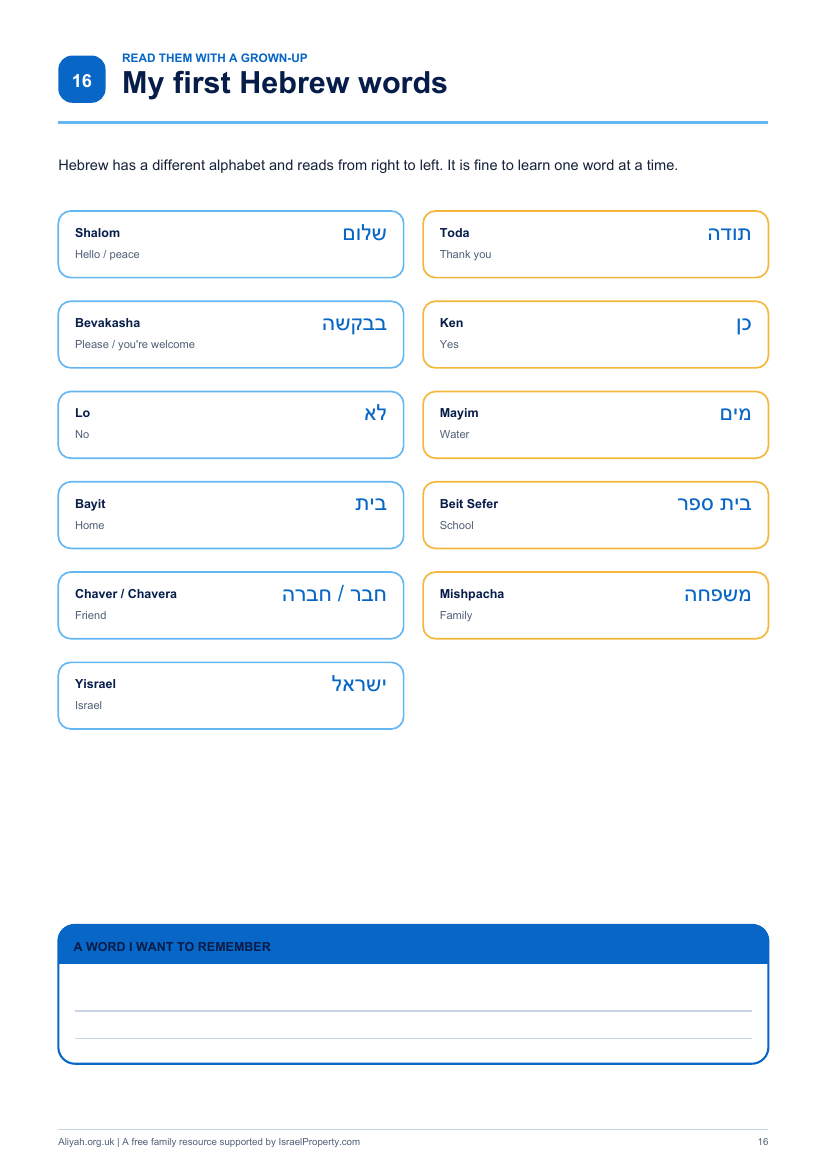
Hebrew word of the journey
One useful word at a time.
Hebrew can be new without becoming a test. Say the word, connect it to the stage and let children come back to it.
ישראל
Yisrael
Israel
משפחה
Mishpacha
Family
בית
Bayit
Home
להתראות
Lehitraot
See you again
מטוס
Matos
Aeroplane
שלום
Shalom
Hello
בית ספר
Beit Sefer
School
No audio is included: families can use a trusted Hebrew speaker or qualified language resource for pronunciation.
For parents
Helping your child through Aliyah.
Aliyah is a big journey for children too. These prompts support honest family conversations without pretending one response or emotion is correct.
01Telling children about the move
Choose a calm moment. Say what is known, what is still being decided and what will happen next. Let the first response be theirs.
02Age-appropriate information
Give enough truth to build trust without handing a child adult worries. Short explanations can be repeated as the move becomes more real.
03Let them have mixed feelings
Excitement, sadness, anger, curiosity and relief can sit together. Avoid describing difficult feelings as bad or disloyal.
04Involve them without making them responsible
Offer real, limited choices about a room, comfort item, goodbye or activity. Adults remain responsible for the decision and logistics.
05Goodbyes
Plan time with important people and places. A goodbye ritual, photo book or future call can make distance easier to understand.
06School transition
Explain the shape of the first day, what support has been requested and who the child can approach. Avoid promising that school will immediately feel easy.
07Language anxiety
Say clearly that nobody expects instant Hebrew. Practise simple help phrases and make 'I don't understand yet' safe to say.
08Keeping UK relationships
Agree realistic ways and times to stay connected. Let children know which relationships adults will help them maintain.
09Building new routines
Rebuild familiar anchors such as bedtime, meals, Shabbat, sport, stories and regular contact, while allowing the new routine to develop.
10Siblings may react differently
Do not use one child as the settling benchmark for another. Give each child private time to describe what is working and what is hard.
11Teenagers need more control and information
Be honest about school, exams, friendships, Hebrew and social life. Invite meaningful involvement and allow disagreement about the move.
12When a child seems to be struggling
Listen, speak with the child and school, and use suitable health or qualified professional support when needed. This resource does not diagnose or provide therapy.
Conversation starters
Questions to open a conversation - not a test.
What are you most excited about?What do you think you will miss?What are you wondering about?Is there anything about moving that feels scary?What would make your new room feel like home?Who do you want to stay in touch with?What do you want your new teacher to know about you?What is one thing you hope stays the same?What would you like to choose about the move?What would make this week easier?
Age-specific help
Meet children at their age and stage.
The same move can feel very different to a four-year-old, a primary-school child and a teenager.
Little ones
Approximately 3-6
Use one page or one idea at a time. Repeat simple truths and show the next concrete event.
The family resources come first. No child entry route is active and no draft terms are shown publicly. If a competition is launched later, the legal promoter, dates, prize, final terms and privacy route must be confirmed first, and entry will be controlled by a parent or legal guardian.
No child contact detailsNo surnames or addressesNo school or travel detailsNo photos or application information
Start together
Some things will change. Some important things can stay the same.
You can be excited about Israel and sad about leaving people and places you love. There is no single right way to feel about moving.